
Skip to content
  • Clear communication
  • Free inspections
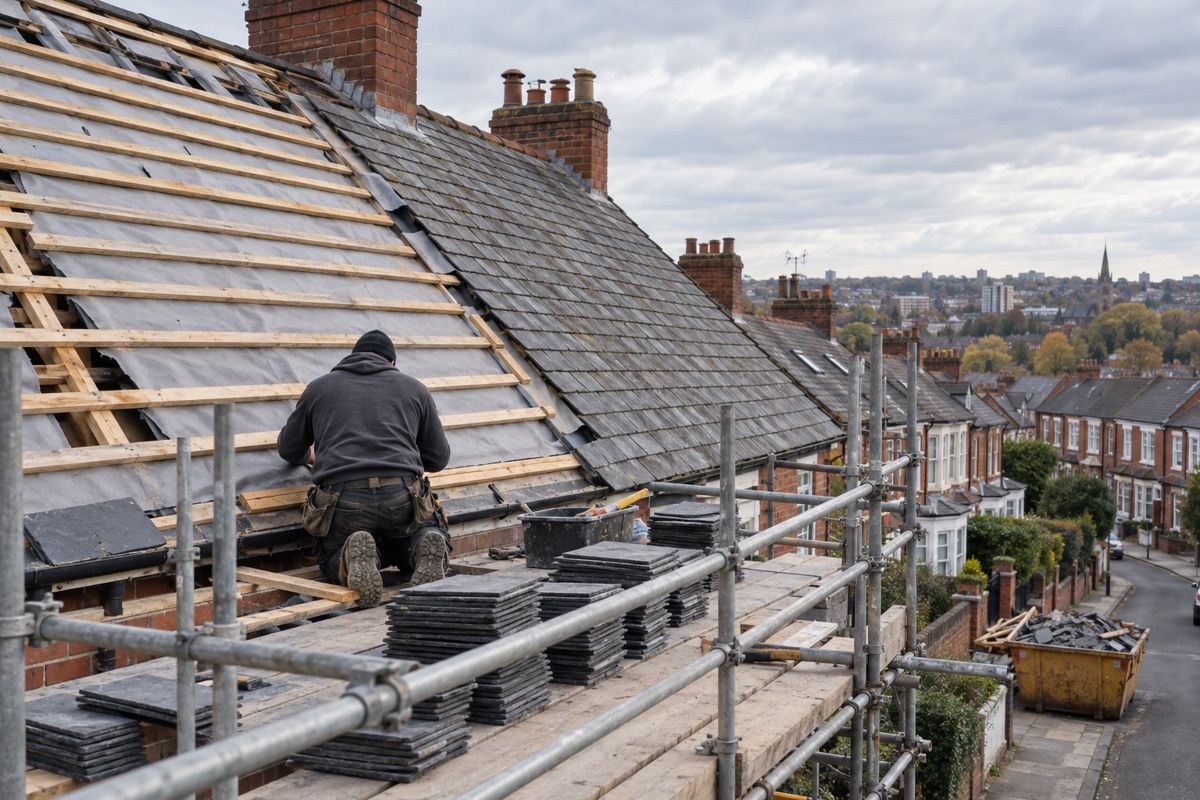
Terraced house with half the old slate roof stripped to new battens

Roof replacement in Nottingham

Roof replacement in Nottingham, done in the right order

Strip, repair the timbers, relay with the right covering and finish the details properly. You get a written quote before we start.

  • Slate, concrete tile and flat roof options
  • Timber and flashing checked as part of the job
  • Written quote with the work spelled out

Step 1 of 3

What do you need?

When does a Nottingham roof need replacing, not repairing?

A repair is the right answer when the damage is local. A few slipped slates, a cracked ridge tile or a worn patch of flashing can be put right without touching the rest. A full roof replacement in Nottingham makes sense when the problems are everywhere, or when fixing one thing keeps leading to another.

Common signs include sagging between the rafters, battens that crumble when you touch them, tiles that flake at the edges, daylight showing in the loft, and damp patches that come back after each repair. Older slate roofs can fail because the fixing nails rust through, even when the slates themselves are still sound. Some 1930s concrete tile roofs reach the end of their life because the underlay beneath has perished.

If you are not sure which side of the line you are on, a roof inspection gives you the facts first. For smaller faults, see our roof repair page.

What does a roof replacement involve?

The sequence matters, because each stage hides the one before it. A typical job runs like this.

  1. Scaffolding goes up so that the crew can work safely and materials can be handled at roof level.
  2. The old slates or tiles, battens and underlay are stripped and taken away.
  3. The rafters, wall plates and eaves timbers are checked, and any rotten or damaged timber is dealt with.
  4. New breathable membrane and treated battens are fixed.
  5. The new slates or tiles are laid, with ridge, hip and verge details fitted.
  6. Lead flashings are formed around chimneys, valleys and abutments, and the roof is cleared and checked.

Fascias, soffits and guttering are often looked at at the same time, because the scaffold is already there. We can discuss what is sensible for your house when we quote.

Which roof covering suits a Nottingham home?

Natural slate is the traditional choice on Victorian terraces and keeps an older street looking right. It lasts a long time when it is fixed well and costs more. Concrete interlocking tiles are common on 1930s semis and later homes. They are quicker to lay and usually cheaper. Clay pantiles suit some older buildings in the county.

Flat roofs on extensions, garages and some bay tops are a different job. Systems such as GRP (fibreglass) and EPDM (rubber membrane) are widely used. The right one depends on the shape of the roof, how the water drains off and the condition of the deck beneath.

In a conservation area or on a listed building, changing the covering can need consent from the council. Check before you choose a material, or ask us what we would expect to be asked for.

We do not give prices on a website, because two roofs that look alike can cost very differently. Size and shape come first. Hips, valleys, dormers and chimneys add time and lead work. The covering you pick makes a large difference, with slate usually costing more than concrete tile.

Access matters too. A terrace on a narrow street may need scaffolding that crosses the pavement, which can need permission from the highways authority. Then there is what is found when the old roof comes off. Rotten battens or damaged rafters are hidden until then, so a good written quote explains how extra work would be priced.

Our home page explains how we quote, and our blog has a rough cost guide for Nottingham. Both treat figures as guides, not offers.

How long does it take and what happens on the day?

A typical house roof takes from several days to a couple of weeks, depending on size, covering and weather. Bad weather can stop work for safety reasons, and we will tell you if dates move. Smaller flat roofs are often quicker.

On the first day, scaffolding is checked and the stripping begins. We protect the loft contents where we can, and ask you to move delicate items and cars from near the house. There will be noise and some dust, and the crew will tidy up as they go. At the end we clear the site and go through the finished work with you.

You should hear from us about any surprises before extra work is done. If you notice a leak or a hole in your roof after storm weather, our storm damage page may be the better place to start.

Clear communication Free inspections Written estimates Local crew

Questions about roofing in Nottingham

How do I know my roof is at the end of its life?

Look for a sagging roof line, many cracked or crumbling tiles, soft or rotten battens, daylight in the loft and damp that keeps returning. None of these alone proves a new roof is needed, but several together usually do. A survey from a ladder or the loft gives a clearer answer. Repeated patching on an old roof often costs more over time than doing the job once.

Do I need to move out while the roof is replaced?

Almost always no. The work is outside, and most families stay at home. There will be noise from stripping, scaffolding on the property and some dust in the loft. You may want to move delicate items out of the top floor and park cars away from the house. Tell us about anyone who works night shifts, has pets or has health needs, and we will plan around it.

Will a new roof need building regulations approval?

It can. Re-covering a large part of a roof is often treated as work that must meet Building Regulations, for example around insulation and ventilation. The details depend on the job and the age of the house. Your local council building control team can confirm what applies to your address, and we can discuss how this would be handled when we quote.

Can you replace a roof on a house in a conservation area?

Often yes, but the rules differ. Some parts of Nottingham are conservation areas, and listed buildings have stricter controls. Changing from slate to concrete tile, or altering the look of the roof, can need consent. Replacing like for like is often simpler. Check with the council before you order materials, and tell us your address so that we can raise the right questions.

What happens if you find rotten timber once the old roof is off?

We stop and show you, with photos where we can. The timber work is then explained in writing, with the extra cost agreed before it goes ahead. The quote should say how this kind of extra is handled, so that it is not a surprise. Sound timber can usually stay, and only the rotten sections are replaced or reinforced.

Request roof replacement

Tell us what you need and we call you back.

No obligation.

Step 1 of 3

What do you need?

Ready when you are. Call now or request a quote online.

How it works

  1. Call or request a quote

    Tell us what is happening with the roof.

  2. Free inspection

    A roofer checks the roof and gives a written price.

  3. Work done right

    Clean crew, nail sweep, warranty in writing.

Takes about 30 seconds. Get my free quote